


Clarence A. Gagnon
 "It was not the over-sensitivity of the misunderstood that made me move to Paris....Over there, I paint only Canadian subjects, I dream only of Canada. The motif remains fixed in my mind, and I don't allow myself to be captivated by the charms of a new landscape. In Switzerland, Scandinavia-everywhere, I recall my French Canada."
Clarence A. Gagnon, 1931
"It was not the over-sensitivity of the misunderstood that made me move to Paris....Over there, I paint only Canadian subjects, I dream only of Canada. The motif remains fixed in my mind, and I don't allow myself to be captivated by the charms of a new landscape. In Switzerland, Scandinavia-everywhere, I recall my French Canada."
Clarence A. Gagnon, 1931
Clarence Alphonse Gagnon was one of the most celebrated Canadian artists of the early 20th century, painting primarily in an impressionist and post-impressionist style. He was also an outstanding draughtsman, a renowned illustrator, and a world-class engraver.
While Gagnon moved back and forth between France and Canada, no location was more important to his artistic legacy than Quebec's Charlevoix region. First visiting the area in the early twentieth century, he became captivated by its dramatic landscapes, charming heritage, and traditions. Although born in Montreal, Baie-Saint-Paul became his Canadian home and over his career, Gagnon transformed the surrounding countryside into some of the most iconic images in Canadian art. With luminous colour and an extraordinary handling of light, he rendered the everyday scenes of Charlevoix into beauty and poetry in paint.
Gagnon was born on November 8, 1881. From 1897 to 1900, he studied drawing and painting under William Brymner at the Art Association of Montreal. In 1904, he left for Paris to work in the studio of Jean-Paul Laurens at the Académie Julian. He was able to distinguished himself early in his career by the fine quality of his engravings. Gagnon won a gold medal at the St. Louis Exhibition in 1904 and an honourable mention at the Salon des artistes français in Paris in 1905. From 1909 to 1914, Gagnon moved between Canada, France, and Norway; most often working up the sketches he had made in Quebec.
Gagnon became a member of the Royal Society of Canada, and in 1910, became an associate member of the Royal Canadian Academy of Arts, then a full member in 1922. In 1923, he received the Trevor Prize of the Salmagundi Club of New York. Between 1924 and 1936, Gagnon returned to Paris and traveled throughout Europe. It was during this period that he illustrated a number of books, including Rouquette's Le grand silence blanc (1929) and the deluxe edition of Louis Hémon's Maria Chapdelaine (1933), a story that celebrated Canadian frontier life. Upon his return to Quebec in 1936, the Université de Montréal awarded him an honorary doctorate.
Gagnon preferred to keep many of his sketches and a large number of them were at his Paris apartment. He returned to Canada in 1936, and several years later World War II began. Gagnon died in 1942, and after the war his widow, Lucille Rodier Gagnon, returned to Paris and reclaimed the sketches. When she sold them, frequently through William Watson, Blair Laing, and Walter Klinkhoff, she applied a label to the reverse. Later, Lucille Rodier Gagnon appointed Walter Klinkhoff to sell the works in her estate for the benefit of her niece. To these, he applied a modified special label.

Paintings
-
 Étude d'automne, Charlevoix, 1939 Oil on panel 6 x 9 in
15.2 x 22.9 cm $40,000 -
 Autumn in Charlevoix, 1923 (circa) Oil on panel 6 x 9 in
15.2 x 22.9 cm $45,000 -
 Été de la St Martin, Baie St. Paul, 1922 (circa) Oil on panel 4 3/4 x 7 1/8 in
12 x 18 cm $50,000 -
 Late March, Baie St. Paul, 1922 (circa) Oil on panel 4 3/4 x 7 in
12.1 x 17.8 cm $45,000 -
 Isola San Burano, Venice, 1905 Etching and drypoint on japanese paper 6 x 8 1/2 in
15.2 x 21.6 cm $3,500 -
 Le Grand Silence Blanc by Louis-Frédéric Rouquette, illustrated by Clarence A. Gagnon $1,500
 -
 Maria Chapdelaine by Louis Hémon, illustrated by Clarence A. Gagnon Edition of 2,000 numbered copies plus an additional 160. This copy is no. 1812. Sold
 -
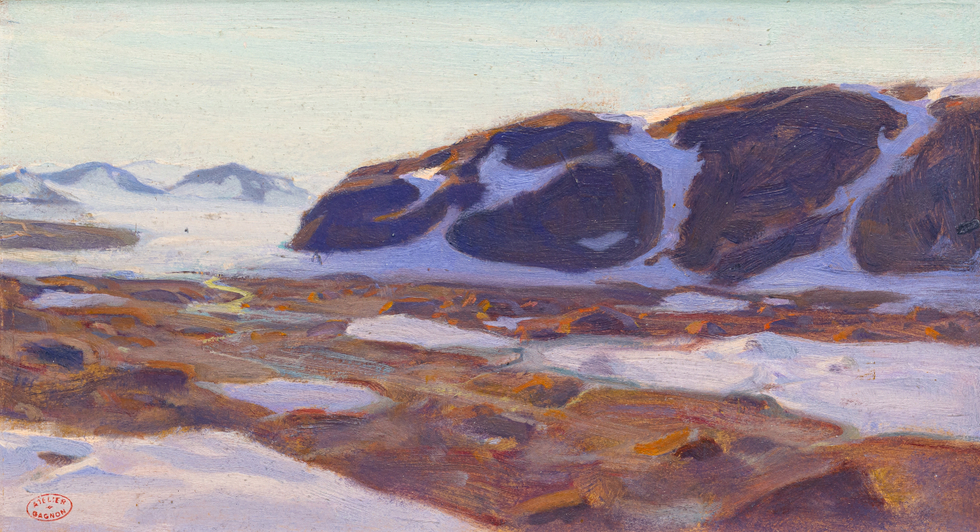 Paysage du Nord Oil on cardboard 5 1/2 x 10 in
14 x 25.4 cm $15,000


