


Frederick B. Taylor
 "E.P. [Taylor], the great business tycoon, may one day only be remembered as being Fred's brother!"
Walter Klinkhoff
"E.P. [Taylor], the great business tycoon, may one day only be remembered as being Fred's brother!"
Walter Klinkhoff
Submit your painting(s) to the Frederick Taylor Inventory Project
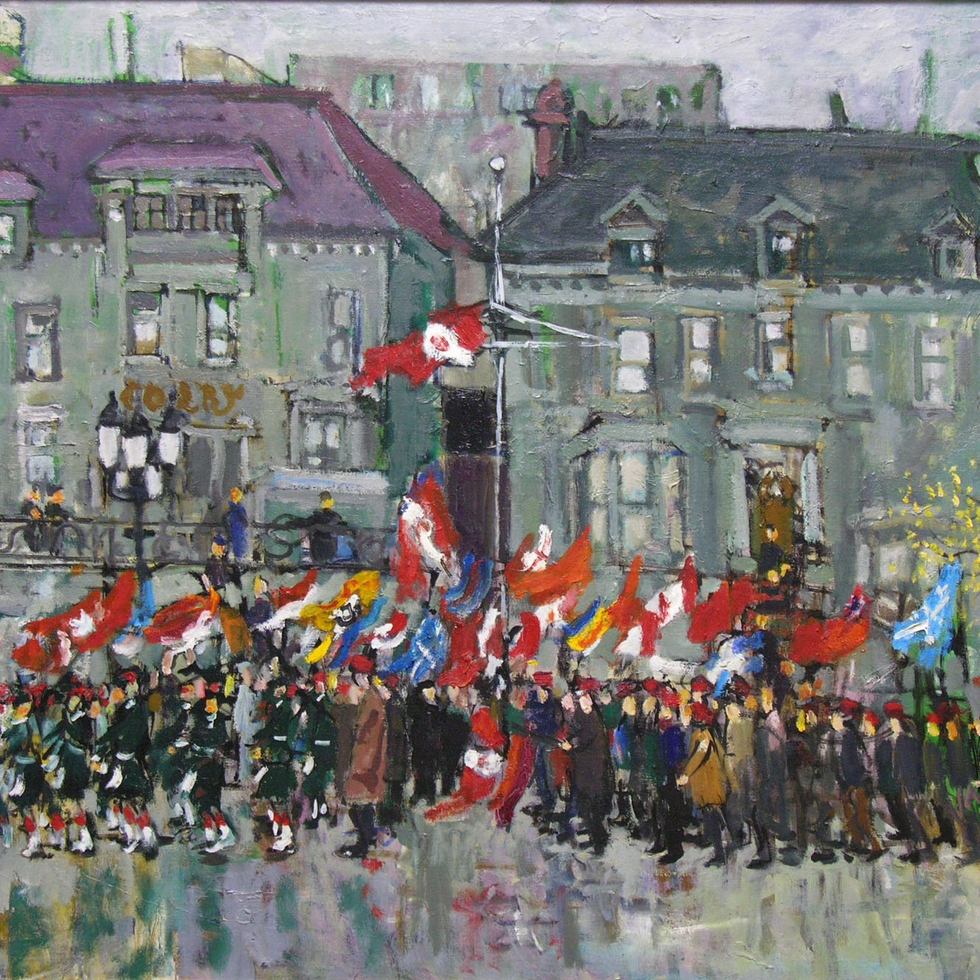
Frederick Bourchier Taylor (1906–1987) was a Canadian painter, printmaker, sculptor, and architectural draftsman best known for his outstanding and technically accomplished depictions of urban life and Canadian industrial workers. Born in Ottawa on July 27, 1906, he came from a prominent Canadian family; his older brother, E.P. Taylor, later became a major Canadian businessman. Taylor studied architecture at McGill University, where he distinguished himself both academically and in drawing. In 1927 he was awarded McGill’s Anglin Norcross Prize for drawing, and graduated from the School of Architecture in 1930. He also developed an interest in skiing and boxing, and sports would form an important body of his early creative work. He also became the university’s heavyweight boxing champion.
After graduation, Taylor continued his artistic training and worked in both Britain and Canada before settling in Montreal in the late 1930s. He studied art and printmaking in London and supported himself in part by painting portraits and teaching drawing at McGill's School of Architecture. By this period he had developed a particular interest in city streets, buildings, workers, and industrial environments.
Taylor also moved within the socially engaged artistic culture of Depression-era Montreal, where artists, intellectuals, and political activists increasingly addressed unemployment, poverty, workers’ rights, and social reform. Taylor’s commitment to labour subjects is well documented. His paintings and prints repeatedly focused on industrial workers, working class life, and the associated neighbourhoods, and his archival papers contain extensive material concerning “art and labour,” “art and society,” industrial painting, and wartime production. He also wrote explicitly on the subject. Taylor was among the first artists to make these ideas a central theme of his art, placing him within a broader Canadian movement toward socially conscious art during the 1930s and 1940s.
After war began in 1939, Taylor pressed the Canadian government to establish an official program for recording the war effort through art. Although his proposal was initially unsuccessful, he independently gained access to railway shops, shipyards, munitions plants, and other wartime industries and produced more than 200 paintings and studies of Canadian workers. Rather than concentrating on battle scenes, Taylor documented the labour behind the war effort; machinists, welders, factory employees, and workers in Montreal's garment and fur industries. These works are notable for their close observation of both factory conditions and the concentration of the people at work. His 1944 lithograph Arc Welder, now in the collection of the National Gallery of Art in Washington, is one example of this industrial subject matter.
Taylor’s work of the 1930s and 40s belongs to a much broader current in which the dignity, labour, and wartime sacrifice of working people assumed new cultural and political importance. His images of children playing, working class neighbourhoods, welders, machinists, factory workers, and other industrial labourers reflected a society increasingly conscious that nationhood depended on the sustained contributions of ordinary Canadians. In the same period, Canada was moving toward a more extensive social welfare system, with growing public support for measures such as unemployment insurance, family allowances, expanded veterans’ benefits, and, later, publicly funded health care. Taylor’s work formed part of the social climate that placed greater value on ordinary Canadians in national life, an idea that became increasingly central to Canadian identity. This prompted Walter Klinkhoff to write in his memoirs that E.P. Taylor, in spite of his formidable business accomplishments, might one day be remembered as Fred’s brother.
In 1960 Taylor moved to Mexico, afterwards returning to Canada mainly for exhibitions and personal needs.
Taylor received substantial professional recognition within Canada’s artistic establishment over the course of his career. He became a member of the Society of Canadian Painters, Etchers and Engravers in 1934, and a lifetime member in 1959. In 1943, he joined the Canadian Society of Graphic Arts. Taylor was also elected to the Royal Canadian Academy of Arts, first as an Associate in 1938 and later as an Academician in 1966.
Taylor's work was featured in solo exhibitions and sales in Montreal, Toronto and Ottawa, including at Walter Klinkhoff Gallery. He received commissions executed for the Government of Canada and major industrial corporations there and in the United States. His work is in the collections of the National Gallery of Canada, the National Gallery in Washington D.C., the Canadian War Museum, and Montreal Museum of Fine Art, to name a selection.
In the 1980s, Taylor asked Alan Klinkhoff to assist with an inventory of his work, which became the basis for a modern inventory project.
Fred Taylor died in Mexico in 1987.
Select Solo Exhibitions
Galerie Walter Klinkhoff, Montreal: 1977, 1985
Galerie Jeanne Newmann, Montreal, 1973
Roberts Gallery, Toronto, 1979

![Frederick B. Taylor, Pouring Residue Bronze into the Chill Moulds [for bronze parts Anti Aircraft Guns] in the Brass Foundry, Dominion Engineering Works, Lachine, Quebec, 1942 (November 5)](https://static-assets.artlogic.net/w_980,h_980,c_limit,f_auto,fl_lossy/artlogicstorage/alanklinkhoff/images/view/22c8182f14847c1bca1e066d26d8e439j/alanklinkhoffgallery-artdealers-appraisers-frederick-b.-taylor-pouring-residue-bronze-into-the-chill-moulds-for-bronze-parts-anti-aircraft-guns-in-the-brass-foundry-dominion-engi.jpg)