


Jean Paul Riopelle
 “There is no abstraction or figuration: there is only expression and expressing oneself is about placing oneself in front of things. To abstract means to take away, to isolate, to separate, whilst I try to do the contrary, to add, to approach, to link”
Jean Paul Riopelle quoted in Y. Riopelle, Jean Paul Riopelle, Catalogue raisonné Volume 2, 1954-1959, Montréal, 2004, p.26).
“There is no abstraction or figuration: there is only expression and expressing oneself is about placing oneself in front of things. To abstract means to take away, to isolate, to separate, whilst I try to do the contrary, to add, to approach, to link”
Jean Paul Riopelle quoted in Y. Riopelle, Jean Paul Riopelle, Catalogue raisonné Volume 2, 1954-1959, Montréal, 2004, p.26).
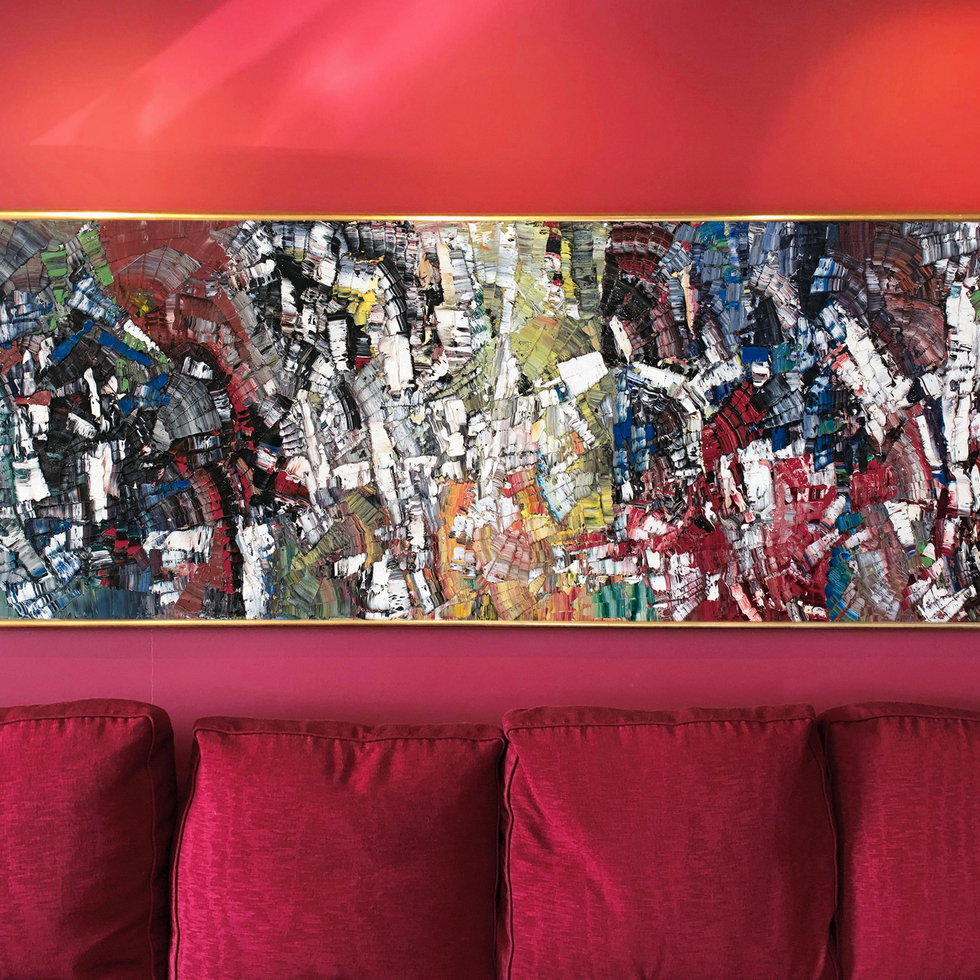
Jean Paul Riopelle (1923–2002) was one of the most internationally significant Canadian artists of the twentieth century and as a leading figure associated with Automatisme, lyrical abstraction, and postwar gestural painting. Born in Montréal, Riopelle studied under Paul-Émile Borduas at the École du meuble and became a member of the Automatistes, signing the landmark 1948 manifesto Refus global. He moved to France at the end of the 1940s and quickly established an international career, becoming especially renowned for dense, mosaic-like paintings built from vigorous applications of paint with a palette knife. Riopelle represented Canada at the Venice Biennale, exhibited extensively in Europe and North America, and worked across painting, sculpture, printmaking, collage and related media. His importance lies in the scale and ambition of his career: he was among the first Canadian-born artists of his generation to achieve sustained recognition within the international postwar avant-garde, while also remaining deeply connected to the cultural history and natural environment of Québec.
Riopelle was born in Montréal on October 7, 1923. After studies at the École Polytechnique and the École des beaux-arts, he enrolled at the École du meuble, where his encounter with Borduas proved decisive. Under Borduas’s influence he moved away from academic painting toward spontaneous, non-representational work and participated in the first exhibition of the Automatistes in Montréal in 1946. The following year he travelled to Paris, where he encountered Surrealist circles and signed the manifesto Rupture inaugurale; in 1948 he was one of the sixteen signatories of Refus global, one of the defining documents of modern Québec culture. Riopelle settled in France shortly afterward and held his first solo exhibition in Paris in 1949. By the 1950s his painting had developed into a highly distinctive language of interlocking strokes and slabs of colour, often spread with a palette knife into complex all-over surfaces. Although closely associated with abstraction, his later work increasingly drew upon landscape, animals, birds, hunting, northern imagery and personal mythology. He returned more frequently to Québec from the late 1960s onward and eventually maintained a major studio and residence there; he died at L’Isle-aux-Grues in 2002.
Riopelle’s exhibition history and institutional recognition were exceptional by Canadian standards. He participated in the Venice Biennale in 1954 and again represented Canada there in 1962, when he received a UNESCO prize; from 1954 he exhibited regularly in New York with Pierre Matisse Gallery, and in 1966 joined Galerie Maeght in Paris. A major retrospective was organized by the National Gallery of Canada in 1963, and in 1981 the Musée national d’art moderne in Paris mounted another retrospective that subsequently travelled internationally. More recently, the National Gallery of Canada marked the centenary of his birth with the retrospective Riopelle: Crossroads in Time in 2023. His work entered major international collections early: MoMA acquired Forest Blizzard in 1954 and today holds several of his works, while the Musée national des beaux-arts du Québec holds more than 500 works and describes its holdings as the largest public collection of his art. Riopelle was named a Companion of the Order of Canada in 1969, received the Prix Paul-Émile-Borduas in 1981 and the Grand Prix de la Ville de Paris in 1985, and was made a Grand Officer of the National Order of Québec in 1994. His work is held by institutions including the National Gallery of Canada, the Musée national des beaux-arts du Québec, the Museum of Modern Art in New York and the National Gallery of Art in Washington, among many others.