


Tom Wesselmann
Tom Wesselmann was an American artist and a central figure in the development of Pop Art in the United States. Considered, alongside Roy Lichtenstein and Andy Warhol, one of the defining artists of the movement, he played a key role in establishing Pop Art’s visual language through flat colour, sharp contours, and imagery drawn from American consumer culture. Born in Cincinnati, Ohio, in 1931, Wesselmann studied at Hiram College and the University of Cincinnati before attending the Art Academy of Cincinnati. After serving in the U.S. Army during the Korean War, he moved to New York in 1956 and enrolled at Cooper Union.
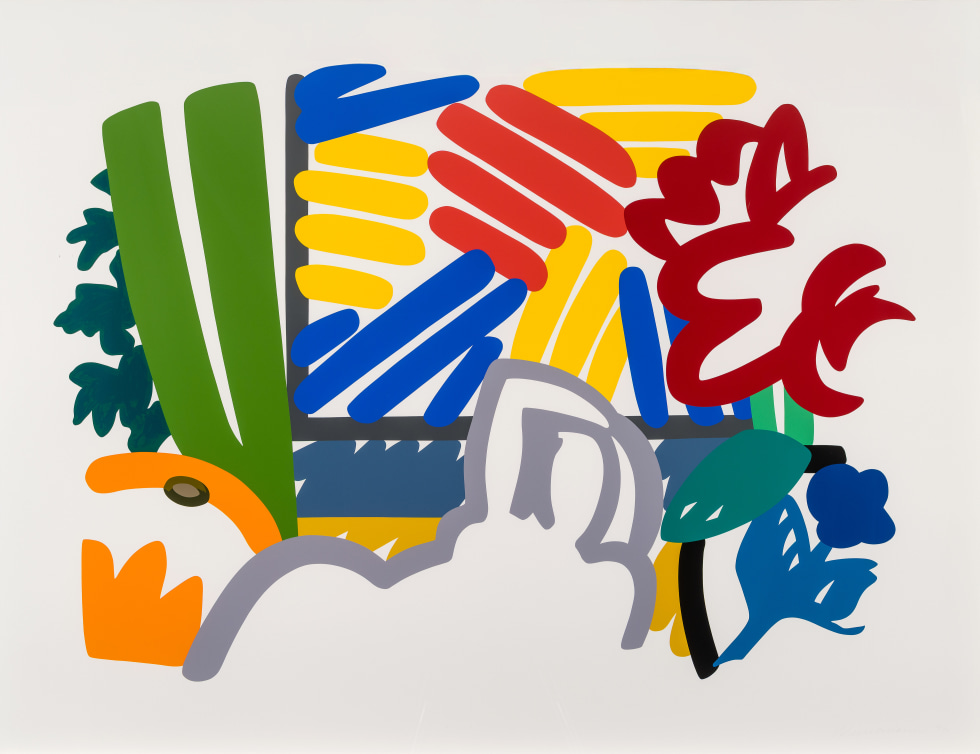
Wesselmann emerged in the early 1960s with work that deliberately rejected Abstract Expressionism in favour of clarity, immediacy, and graphic precision. His Great American Nude series established his reputation and became one of the most recognizable bodies of work associated with Pop Art. Over the following decades, he expanded his practice to include still lifes, shaped canvases, metal cut-outs, and screenprints, consistently combining everyday objects with references to art history while working across painting, sculpture, collage, and printmaking.
Although closely associated with the formative years of Pop Art, Wesselmann’s work was long underrepresented in major American museum exhibitions during his lifetime. In recent years, his contribution has been increasingly reassessed, particularly in relation to his sustained productivity, technical refinement, and influence on subsequent generations of figurative artists. His work is held in major museum collections, including the Museum of Modern Art, New York; the Whitney Museum of American Art; the Art Institute of Chicago; the Tate Gallery, London; and the National Gallery of Art, Washington, D.C. Wesselmann lived and worked in New York until his death in 2004.