


Francesco Iacurto
Colour was Francesco Iacurto's greatest language. Whether depicting a fishing village along the St. Lawrence, a snow-covered road in Charlevoix, or a bustling harbour on the Gaspé coast, he approached every subject with an instinctive understanding of how colour could transform a familiar scene into something memorable. Throughout a career that spanned more than six decades, Iacurto became one of Quebec's most beloved landscape painters, celebrated for works that combine technical confidence with an unmistakable sense of joy and vitality.
Born in Montreal in 1908 to Italian immigrant parents, Iacurto grew up in a city rich with cultural influences. His artistic education began at the Council of Arts and Manufactures before continuing at the École des beaux-arts de Montréal, where he received rigorous academic training. Yet while he mastered the fundamentals of drawing and composition, it was the experience of travelling and painting directly from nature that would ultimately shape his artistic identity.
Like many Canadian artists of his generation, Iacurto was drawn to the province's rural regions in search of inspiration. The villages of Charlevoix, the shores of the St. Lawrence, the Gaspé Peninsula, and the Côte-Nord provided subjects that he would revisit throughout his life. What attracted him was not simply the beauty of these places, but their character—the brightly painted houses perched along a shoreline, the rhythm of fishing boats in a harbour, or the changing light that transformed a familiar landscape from one season to the next.
Unlike artists who sought drama through monumental scenery, Iacurto found richness in everyday life. His paintings often celebrate the built environment as much as the natural one, weaving together architecture, landscape, and human presence into harmonious compositions. Churches, homes, wharves, and village streets become integral parts of the visual story, reflecting a deep appreciation for the communities that shaped Quebec's cultural landscape.
His work is instantly recognizable for its vibrant palette and energetic brushwork. Rather than faithfully reproducing colours exactly as they appeared, Iacurto often intensified and orchestrated them to heighten the emotional impact of a scene. Brilliant reds, luminous blues, and warm earth tones animate his compositions, creating paintings that radiate warmth and optimism. This sensitivity to colour gave his work broad appeal and remains one of the reasons collectors continue to be drawn to it today.
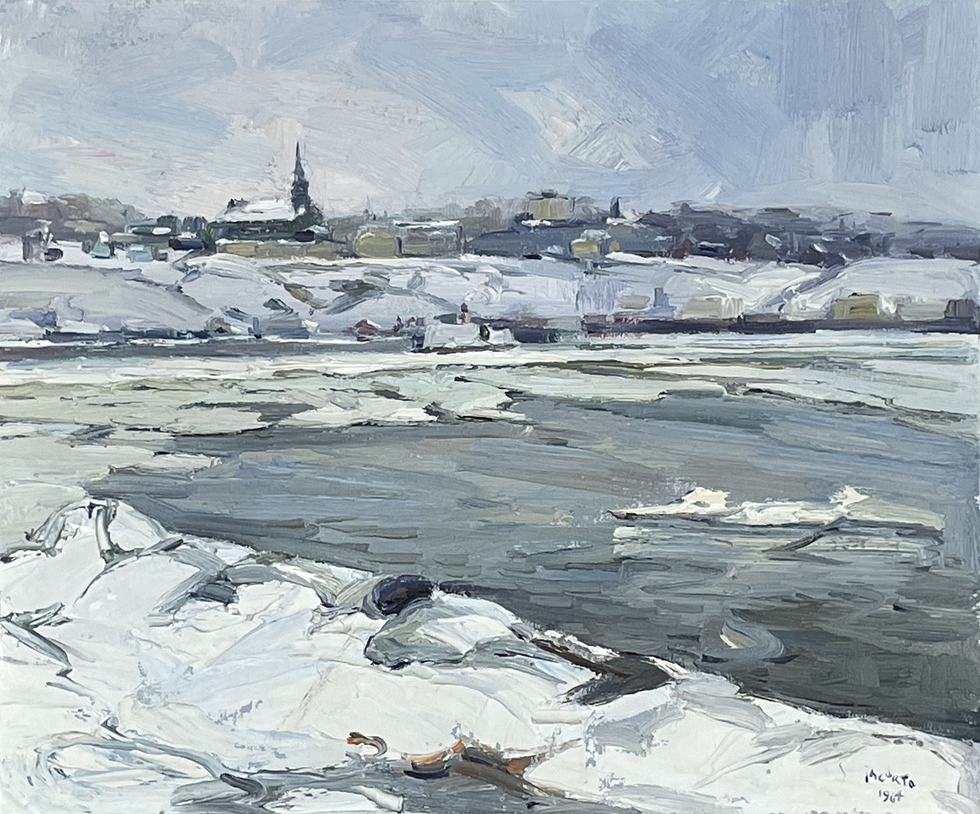
The changing seasons provided endless opportunities for exploration. Winter scenes, in particular, became an important part of his oeuvre. Snow-covered villages, frozen rivers, and crisp northern skies allowed him to experiment with subtle tonal contrasts while preserving the brightness and energy that characterized his work. Whether painting summer harbours or winter roads, Iacurto consistently conveyed a sense of place that feels both immediate and inviting.
As his reputation grew, Iacurto exhibited widely throughout Canada and earned recognition from both institutions and private collectors. He was elected to the Royal Canadian Academy of Arts, a reflection of the esteem in which his work was held by his peers. Yet despite his success, he remained committed to the subjects that had inspired him from the beginning, continuing to paint the landscapes and communities he knew best.
More than a chronicler of Quebec scenery, Iacurto was a painter of atmosphere, colour, and lived experience. His work captures not only what these places looked like, but what it felt like to stand within them—to experience the warmth of a village, the freshness of coastal air, or the quiet beauty of a winter afternoon. In doing so, he created a body of work that continues to resonate with viewers who recognize in his paintings a celebration of both place and everyday life.