

Art canadien classique


Cross Road, 1972
Oil on canvas
28 3/4 x 23 5/8 in
73 x 60 cm
73 x 60 cm
This painting is presently on view at our Toronto gallery
$225,000
Inscriptions
signed, 'Riopelle' (lower right); inscribed, ‘Y19180’ (verso, stretcher)Provenance
Galerie Maeght, Paris
Galerie Martal, Montréal
Private collection, Montreal
By descent, private collection, Montreal, Quebec
Documentation
Catalogue raisonné de Jean Paul Riopelle, tome 5, 1972-1979, Hibou Éditeurs, Montréal, 2020, p. 88
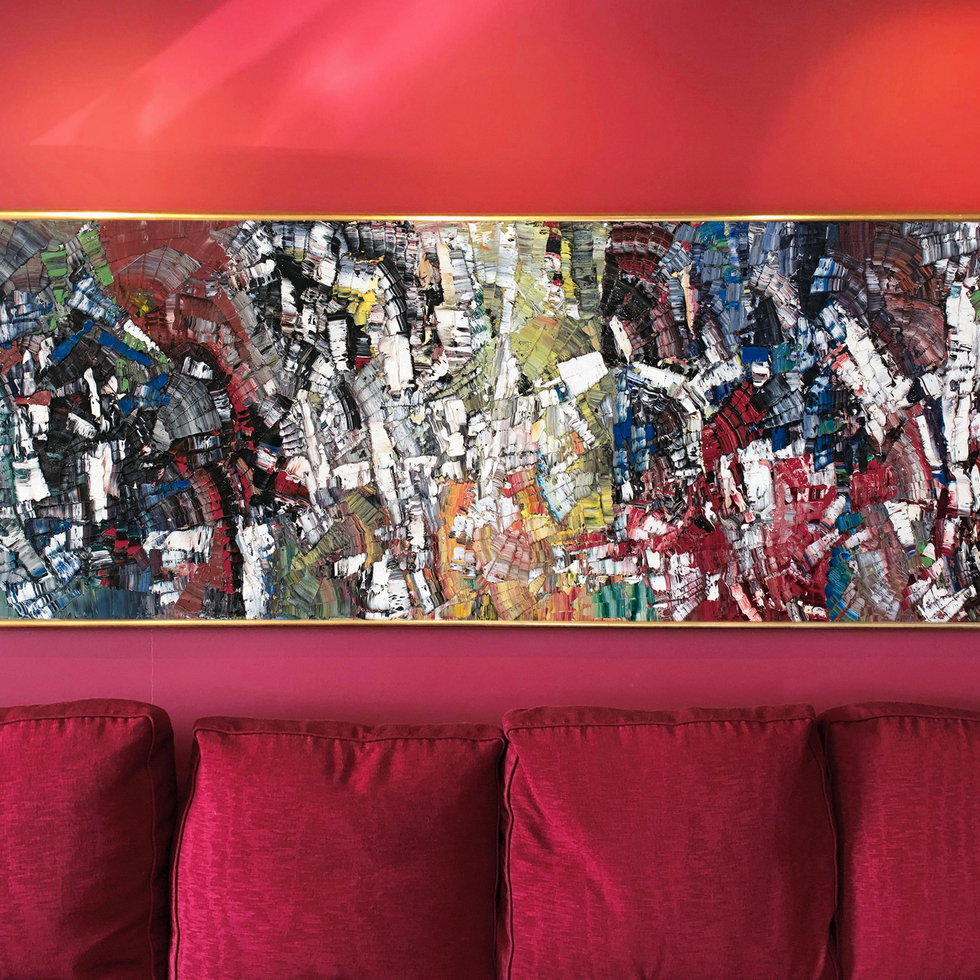
The aesthetic pleasure of Jean-Paul Riopelle’s Cross Road (1972) comes from the sheer richness and vitality of its painted surface. The work is immediately delightful to the eye because of its marvelous colour and texture. Thickly applied paint creates a tactile, almost sculptural surface in which silvery greys, whites and blacks are animated by luminous flashes of turquoise, red, and orange, while larger areas of deep greens and reds create an exhilarating perimeter. The palette knife drags colours through one another without completely blending them, producing subtle variations within every stroke. This gives the painting a jewel-like complexity: the eye continually discovers new combinations of colour, ridges of impasto and small moments of unexpected brilliance.
This sensuous abundance is made even more satisfying by the strong underlying structure of the composition. Bold black and red-black diagonals cut through the dense mosaic of colour - imagery appropriate to the title - intersecting and directing the eye across the surface. The resulting tension between freedom and control, complexity and order, makes the work visually compelling rather than merely chaotic.
Cross Road belongs, fittingly, to a pivotal period in Jean-Paul Riopelle’s career. It is one of a very small number of oil paintings definitively dated 1972 in the Catalogue Raisonné; There are perhaps as few as two, making it an exceptionally rare work from this year. By the early 1970s, Riopelle had long been an established figure on the international art scene, having emerged from the postwar avant-garde to achieve worldwide recognition as a leading exponent of lyrical abstraction in France. He was also beginning to return to Canada more frequently, and by 1974 he would have a studio at Sainte-Marguerite-du-Lac-Masson.
No contextualization of Riopelle is complete without a mention of his membership in the Automatistes. Riopelle was a member of this radical Montreal group of artists whose landmark 1948 manifesto Refus Globalrejected artistic convention and Quebec’s conservative establishment in favour of free expression and liberation from convention, helping to lay the cultural groundwork for the province’s later Quiet Revolution.
This sensuous abundance is made even more satisfying by the strong underlying structure of the composition. Bold black and red-black diagonals cut through the dense mosaic of colour - imagery appropriate to the title - intersecting and directing the eye across the surface. The resulting tension between freedom and control, complexity and order, makes the work visually compelling rather than merely chaotic.
Cross Road belongs, fittingly, to a pivotal period in Jean-Paul Riopelle’s career. It is one of a very small number of oil paintings definitively dated 1972 in the Catalogue Raisonné; There are perhaps as few as two, making it an exceptionally rare work from this year. By the early 1970s, Riopelle had long been an established figure on the international art scene, having emerged from the postwar avant-garde to achieve worldwide recognition as a leading exponent of lyrical abstraction in France. He was also beginning to return to Canada more frequently, and by 1974 he would have a studio at Sainte-Marguerite-du-Lac-Masson.
No contextualization of Riopelle is complete without a mention of his membership in the Automatistes. Riopelle was a member of this radical Montreal group of artists whose landmark 1948 manifesto Refus Globalrejected artistic convention and Quebec’s conservative establishment in favour of free expression and liberation from convention, helping to lay the cultural groundwork for the province’s later Quiet Revolution.